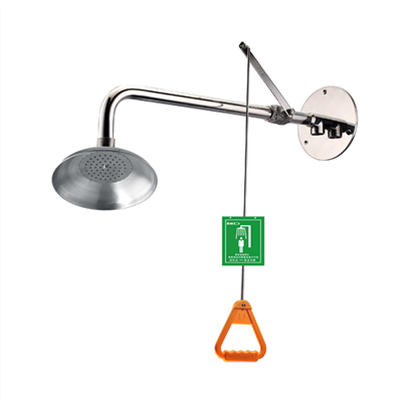


Why Chemical Plants Must Equip Standard Emergency Shower And Eye Wash Systems
Leave a message
Chemical plants involve frequent handling of corrosive acids, alkalis and toxic chemicals, where splash accidents may cause irreversible eye and skin damage to workers. As mandated by ANSI Z358.1 standards, Emergency Shower and Eye Wash systems serve as indispensable first-aid facilities for high-risk chemical workshops, effectively reducing injury severity during sudden leakage and splash incidents.
Verified domestic chemical plant cases fully prove that standardized, equipped and well-maintained emergency flushing equipment can effectively protect staff, while improper placement, blocked access and neglected maintenance often lead to aggravated occupational injuries.

Typical Domestic Case 1: Blocked Equipment Causes Permanent Ocular Damage
In 2024, an East China chemical worker suffered a sodium hydroxide eye splash during pipeline cleaning. The on-site Emergency Shower and Eye Wash station was blocked by stacked materials, causing a 7-minute delay in standard flushing. The worker sustained permanent mild corneal damage with long-term visual discomfort, incurring substantial medical costs. The investigation attributed the accident to missing weekly inspections and unregulated emergency passage management.
Typical Domestic Case 2: Improper Maintenance Leads to Equipment Failure
In 2023, a northern chemical plant closed pipeline water valves in winter to prevent freezing, completely disabling all emergency flushing units. During a hydrofluoric acid leakage accident, the failed Emergency Shower and Eye Wash system caused delayed flushing, resulting in severe secondary skin burns. In another common negligence scenario, long-term untested pipelines suffer sediment accumulation and nozzle clogging, which directly fails emergency rescue needs.
Typical Domestic Case 3: Standardized Management Avoids Personnel Injury
In contrast, standardized South China chemical parks strictly implement weekly activation tests, semi-annual fluid replacement and annual parameter calibration for all Emergency Shower and Eye Wash devices. During a 2025 acid splash incident, the on-site unit activated instantly with standard water flow and qualified tepid water. The worker completed a full 15-minute flush without permanent injury, underscoring the critical value of ANSI-standard daily maintenance.
Chemical plants shall adopt a hybrid layout of fixed plumbed and portable Emergency Shower and Eye Wash systems based on on-site risk distribution. Core production areas shall use fixed units, while temporary and outdoor work zones shall use portable equipment to cover safety blind spots. All equipment must comply strictly with ANSI Z358.1-2014 technical parameters for installation and acceptance.
|
Equipment Type |
Standard Water Flow Rate |
Standard Water Temperature |
Minimum Continuous Working Time |
Applicable Scenarios |
|
Fixed Body Shower |
≥76 L/min |
16℃–38℃ tepid water |
15 minutes |
Reaction workshops, batching stations, chemical storage areas |
|
Fixed Eye & Face Wash |
≥11.4 L/min |
16℃–38℃ tepid water |
15 minutes |
Sampling ports, chemical laboratories |
|
Portable Self-contained Unit |
≥1.5 L/min (single nozzle) |
Clean stored tepid water |
Tank capacity dependent |
Temporary maintenance, outdoor mobile operations |


Industrial audit data shows that over 60% of aggravated chemical splash injuries are caused by untested or poorly maintained emergency equipment. Common on-site defects include blocked access, valve jamming, stagnant water pollution, and winter pipeline freezing. Per ANSI Z358.1 specifications, fixed units require weekly 3–5 minute flushing tests and annual professional calibration; portable units need full water and bacteriostatic solution replacement every six months to maintain emergency availability.
As industrial safety supervision becomes increasingly rigorous, chemical enterprises must ensure full ANSI Z358.1 compliance for Emergency Shower and Eye Wash systems, including standardized configuration, periodic testing, and complete inspection records. Compliant equipment supports third-party safety audits and provides reliable occupational health protection for frontline workers.
Safety experts recommend a hybrid deployment strategy: fixed units for high-risk permanent zones and portable units for temporary blind spots. Combined with standardized inspections and regular emergency drills, this mode effectively avoids equipment failure risks. Many domestic standardized chemical parks have adopted this solution, achieving zero equipment-related safety incidents for consecutive years.
About Us
We are a professional ANSI Z358.1-certified manufacturer of Emergency Shower and Eye Wash systems, specializing in chemical-grade safety equipment R&D, production, and customized layout solutions. We provide one-stop services, including on-site guidance, standardized testing, training, and long-term after-sales support for global chemical enterprises.
FAQ
Q1: Why are Emergency Shower and Eye Wash systems mandatory for chemical plants?
A1: Chemical plant acid, alkali and toxic chemical splashes can cause irreversible eye and skin damage in minutes. ANSI Z358.1-certified Emergency Shower and Eye Wash systems deliver standard tepid water flushing to minimize injury risks. Non-compliant or improperly configured equipment is a major cause of aggravated chemical splash injuries in domestic chemical industry cases.
Q2: Fixed vs Portable units: Which suits chemical plant scenarios?
A2: Fixed plumbed units are mandatory for permanent high-risk zones (reaction workshops, batching and chemical storage areas), supporting stable pressure and 15-minute continuous ANSI-standard flushing. Portable tank-type units are pipeline-free, ideal for temporary maintenance and outdoor sites to fill safety blind spots, but cannot replace fixed units for severe chemical splash rescue.
Q3: What are the core ANSI Z358.1 technical parameters?
A3: Fixed body shower: ≥76 L/min flow rate; Fixed eye/face wash: ≥11.4 L/min; Portable single nozzle: ≥1.5 L/min. All equipment requires 16℃–38℃ tepid flushing water, with fixed systems supporting a minimum 15-minute continuous emergency flushing duration.
Q4: What is the standard testing and maintenance cycle?
A4: Per ANSI Z358.1 requirements: Fixed units need weekly 3–5 minute activation flushing to remove stagnant water and check usability, plus annual professional calibration and inspection. Portable units require full water and bacteriostatic solution replacement every 6 months to avoid contamination and nozzle clogging.
Q5: What common on-site issues lead to emergency equipment failure?
A5: Summarized from domestic chemical accident data, three high-risk issues dominate: blocked equipment access due to material stacking, manual water valve closure or pipeline emptying in winter, and long-term missing tests causing nozzle blockage. These irregular operations account for over 60% of aggravated splash injuries.
Q6: Can portable eye wash replace fixed units for long-term working areas?
A6: No. ANSI Z358.1 clearly requires fixed plumbed Emergency Shower and Eye Wash systems for continuous high-risk chemical exposure areas. Portable units only serve as auxiliary safety equipment for temporary scenarios and cannot pass formal compliance audits.
Q7: What is the correct chemical splash emergency operation?
A7: Immediately use the nearest Emergency Shower and Eye Wash station for continuous 15-minute flushing. Keep eyelids open during eye flushing to thoroughly remove chemical residue. Seek professional medical treatment only after completing standard on-site flushing to prevent secondary injury.