


Your Professional Lab Tap Supplier
Founded in 1982, Hebei Runwangda Laboratory Equipment Co., Ltd. operates a 26,000㎡ headquarters with a team of over 150 skilled employees. The factory integrates complete in-house production lines, including gravity casting, stamping, CNC machining, polishing, electroplating, plastic spraying, laser marking, and final assembly. Supported by a 2,000㎡ finished-goods warehouse, we ensure stable capacity and timely delivery. Our core equipment includes HAAS CNC machining centers, EDM systems, line-cutting machines, and advanced testing instruments such as spectrometers, salt-spray testers, and pressure and flow testing machines. These capabilities allow Runwangda to provide reliable, consistent manufacturing for global laboratory and industrial applications.


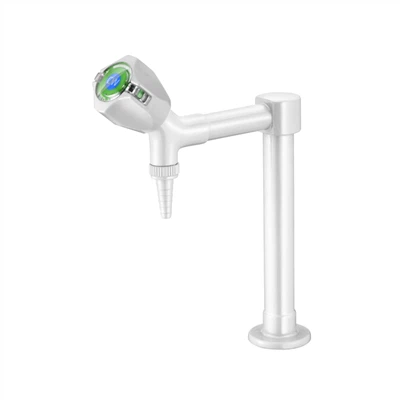


Laboratory Water Taps
Lab water taps are typically brass, stainless steel, or plastic. They provide a clean and controlled water source for various experiments and procedures. Some taps have single or multiple heads to help scientists get adequate water. Users can control the water flow and its temperature according to their needs and requirements.
|
Body Material |
Solid brass |
|
Coating |
High grade epoxy powder, resistant to most chemicals UV fading & heat |
|
Ceramic valve |
90°Turn ,500,000 life cycles , water static pressure Max.25 Bar |
|
Accessory |
Detachable brass serrated nozzle ,splash-controlled water filter attachable |
|
Handle |
Ergonomic,high grade Pp knob |
|
Gooseneck spout |
360°Swing |
|
Color |
White&Grey |
|
Origin |
Hebei,China |
|
Warranty |
2 Years |
|
Standard Export Packaging |
Corrugated box with edge guards, mounted on a palletized base for ocean/land freight .Moisture-proof film wrapping to prevent rust during transit |
|
Loading Port |
Tianjin/shanghai |
Advantages Of Laboratory Water Taps
Precision Control
Laboratory faucets allow scientists to precisely regulate the flow of liquids and gases. This feature enables accurate measurements and controlled experimentation.
Safety
These fixtures are equipped with ergonomic handles and built-in safety mechanisms to minimize the risk of accidents. Moreover, chemical resistant taps also ensure a safer working environment for laboratory personnel.
Contamination Prevention
Laboratory tapware is designed with materials that resist corrosion and chemical reactions. It also reduces the likelihood of contamination and preserves the integrity of experiments and samples.
Versatility
With various configurations and options, this anti-corrosion tapware can accommodate diverse experimental needs, from delicate titrations to high-pressure reactions. It also helps scientists to experiment with different materials.
Efficiency
Easy to use and maintain, laboratory gas taps streamline workflow processes, saving time and effort for researchers and technicians. Moreover, this tapware lets the user mix different liquids or gases simultaneously.
Durability
Constructed from high-quality materials, lab tapware is built to withstand the rigors of laboratory use. This small tool also provides long-lasting performance and reliability to all lab experiments.

Types Of Laboratory Water Taps
Bib Taps
The most common type of lab water tap is the bib tap. Bib taps have a handle that turns to turn the water on and off. They are simple to use and relatively inexpensive, but it can be difficult to precisely control the flow of water.
Safety/Emergency Eye Wash Taps
While not used for experiments, safety or emergency eye wash taps are crucial in laboratories for rinsing eyes during accidental exposure to hazardous substances. Installing these emergency eye wash stations is a must in each lab setting.
Gooseneck Taps
Another common type of lab water tap is the gooseneck tap. Gooseneck taps have a long, curved spout that allows for more precise control of the water flow. They are also available with a variety of spout lengths and materials.
Mixer Taps
These integrate hot and cold water supplies, allowing for precise temperature control, which is crucial for experiments requiring specific water temperatures. Mixer taps are ideal for preparing buffers or media solutions at specific temperatures.
Fume Cupboard Taps
Fume cupboard taps are specially designed for use in fume cupboards. They have a long spout that allows the user to reach the water supply without entering the fume cupboard. They may also have a built-in vacuum breaker to prevent backflow of contaminated water.
Applications Of Laboratory Water Taps
Sample Preparation: In many experiments, mixing samples or making solutions with clean water is vital to avoid adding unwanted materials and get correct results. Lab water taps are a trusted way to get this pure, uncontaminated water.
Chemical Reactions: Many complex chemical reactions always require distilled or pH-neutral water. These specialised lab water taps are essential to cater to this need. Moreover, these taps also help to use the proper amount of water without ruining the experiment’s integrity.
Buffer and Media Preparation: When doing biology experiments, buffers and growth mediums need pure water to ensure the acidity levels are right and nothing unwanted grows in the experiments or samples. However, these taps do not mess with the buffers during the experiment.
Cleaning and Rinsing: It’s crucial to clean all the beakers and tools with water that doesn’t have any contaminants to ensure leftovers from one experiment don’t mess up the next. Lab sink taps give a constant source of clean water for efficient cleaning.
Dispensing Water for Instruments: Certain laboratory instruments, like spectrophotometers or autoclaves, may require purified water for optimal performance. Scientific grade tapware acts as the access point for this productive water supply.
Fume Hood Applications: Experiments involving hazardous chemicals often occur in fume hoods. Fume cupboard taps, a specialised laboratory tap, provide a safe way to access clean water within the fume hood without compromising containment.
Precise Water Flow and Temperature Control of Laboratory Water Taps
Ceramic Cartridge Valves
Provide smooth, drip-free operation and precise control over water flow. They are wear-resistant and ideal for frequent use.
Thermostatic Mixing Valves
Automatically blend hot and cold water to maintain a constant, safe output temperature—preventing scalding during sensitive procedures.
Flow Limiters
Help conserve water and maintain consistent pressure, especially useful in shared lab spaces or high-demand applications.
Installation Methods
Countertop
Mounted to the lab bench using a fixed base; suitable for most standard lab benches.
Wall-mounted
Directly fixed to the wall, saving benchtop space; commonly used in labs with limited space.
Extended Flexible Hose
Some models are equipped with an extended flexible hose, expanding the operating range and facilitating the cleaning of large equipment or corner areas.
Daily Cleaning: Wipe down the tap body and spout with a soft cloth and a mild, non-abrasive, acid-free cleaner to remove chemical residues, dust, and microbial buildup.
Deep Cleaning Schedule: Perform a thorough cleaning weekly using disinfectants compatible with the tap material (e.g., 70% ethanol for stainless steel).
Inspect for Leaks: Check around the base, handle, and connections regularly. Even minor drips can lead to water damage or create slip hazards.
Check Aerator and Filters: Clean or replace aerators to prevent clogging, especially in areas with hard water.
Replace Worn Seals and Cartridges
Over time, internal components like O-rings and valve cartridges degrade. Proactive replacement prevents sudden failures.
Calibrate Sensor Taps
Test infrared sensors monthly and clean the lens to ensure proper detection and response.
Lubricate Moving Parts
Use manufacturer-recommended lubricants on handles and swivel joints to maintain smooth operation.
FAQ
We're well-known as one of the leading lab tap manufacturers and suppliers in China. If you're going to buy customized lab tap, welcome to get quotation from our factory. For price consultation, contact us.