


Your Professional Lab Water Tap Supplier
Founded in 1982, Hebei Runwangda Laboratory Equipment Co., Ltd. operates a 26,000㎡ headquarters with a team of over 150 skilled employees. The factory integrates complete in-house production lines, including gravity casting, stamping, CNC machining, polishing, electroplating, plastic spraying, laser marking, and final assembly. Supported by a 2,000㎡ finished-goods warehouse, we ensure stable capacity and timely delivery. Our core equipment includes HAAS CNC machining centers, EDM systems, line-cutting machines, and advanced testing instruments such as spectrometers, salt-spray testers, and pressure and flow testing machines. These capabilities allow Runwangda to provide reliable, consistent manufacturing for global laboratory and industrial applications.


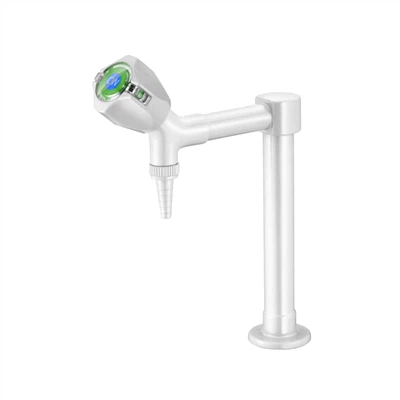


Three Way Lab Faucet
Three Way Lab Faucet is a special kind of faucet that is mostly used in laboratories. It has three outlets, which are the regular two for hot and cold water, but the third one is for getting water in a different way. This faucet is very useful in labs because it provides water for experiments and cleaning in a special way. It is needed in science and medical facilities.
|
Body |
Solid brass |
|||
|
Coating |
High gloss epoxy powder,resistant to most chemicals,UV fading& heat |
|||
|
Ceramic headwork |
90° Turn ,500,000 life cycles,water static pressure Max.10 Bar |
|||
|
Accessory |
Detachable brass serrated nozzle,splash-controlled water filter attachable |
|||
|
Handle |
Ergonomic,high grade PP knob |
|||
|
Gooseneck spout |
360° Swing |
|||
|
Sink |
PP / Ceramic / Epoxy Resin |
|||
|
Faucet |
Brass body with ceramic valve core, coating with epoxy powder coating. |
|||
|
Socket |
Multi-Functional with splash-proof box and safeguard cover |
|||
Features of Three Way Lab Faucet
High-quality materials
The 3-way lab taps are made from high-quality materials like brass, stainless steel, and chrome. These materials are resistant to corrosion and water.
Durable construction
The taps are built with durability in mind. They are heavy-duty and can withstand frequent usage.
Easy installation
The 3-way lab taps are easy to install. They come with braided hoses and control valves. The user only connects the hoses to the water source and the tap and the control valve.
Compatibility
These taps are compatible with different types of labs. They can fit into any lab that has standard water outlets.
Maintenance
The 3-way lab taps are easy to maintain. They don't develop any issues like leaks because they are durable and made from quality materials.
Cleanliness
The 3-way taps are clean. They don't have dirt or dust because they are used in controlled environments. The lab is always clean and organized.
Types of Three Way Lab Faucet

Standard Straight: This is the regular outlet that comes with the 3-way lab tap. It provides water that is used in experiments, cleaning, and other laboratory functions.
Swivel: This outlet has a unique feature that allows it to go around. It can turn 360 degrees. The swivel outlet is good because it gives access to different parts of the sink. It helps to get water in any direction without moving the whole faucet.
Pull-out: The pull-out outlet is connected to a hose. The hose can be pulled out from the tap. This makes the faucet very flexible. Water can be directed to different places without any restriction. The faucet is useful for cleaning big containers and parts of the sink that are hard to reach.
Curved Spout: The design of the curved spout outlet is aerated. It has a curved shape that looks like it is hanging. This makes it look nice and is good for labs that want a curved faucet that is stylish and functional.
Retractable: This outlet has a hose that can be hidden inside the tap. When the water is not needed through the hose, it can be kept away. This helps to keep the sink area neat and stops things from being blocked.
Extended: The extended outlet is longer than usual. It can reach all the corners of the sink easily. This is good for cleaning big containers and parts of the sink that are hard to reach.

Applications of Three Way Lab Faucet
Laboratories
3 Way lab taps are mainly designed for laboratories. They provide water and easy liquid transfer in lab experiments and chemical reactions. The 3 way faucet allows the direct filling of test tubes and beakers. This minimizes spillage and improves precision. The 3 way tap also works well with different lab equipment, including liquid dispensers and syringes.
Kitchens
Many kitchens now incorporate a 3 way lab tap because it offers a better alternative to the single nozzle tap. The 3 way tap provides an additional water source, making it useful for food preparation. It also helps in cleaning tasks. The 3 way faucet reduces the time and effort needed to transfer water from the main tap to clean dishes or fruits.
Healthcare Facilities
3-Way taps are commonly used in healthcare facilities because of their hygienic and convenient design. The 3 way lab faucet provides sterile water for cleaning and cooking. The water can be accessed with minimal hand contact, which helps to reduce the spread of germs. These taps can also be used for rinsing medical instruments.
Brewing And Winemaking
3-Way taps are popular in brewing and winemaking facilities because they help with the processing and cleaning of tasks. The 3 way tap provides water for cleaning fermentation vessels, brewing equipment, and rinsing. The 3 way lab tap can also be used to transfer liquids, such as wort or wine, into containers.
Aquarium And Marine Facilities
3-Way taps are used in marine facilities for different purposes. The taps provide water for cleaning tanks or containers. They also help in the direct filling of containers with freshwater or saltwater. This is important in marine facilities that rear fish and other aquatic animals.
Educational Institutions
3-Way lab taps are commonly found in schools, colleges, and universities, especially in science labs. The taps provide an additional water source for experiments and scientific research. The 3-way taps can also be used to demonstrate the operation of different types of faucets in practical lessons.
How to choose Three Way Lab Faucet
Functional Requirements
The first step is to determine the functional requirements of the 3-way faucet. Consider the tasks that will be performed, such as filling containers, washing hands, or conducting experiments. Look at the water flow requirements and temperature control. Some 3-way faucets provide cold and hot water, while others have water at room temperature.
Build Material
The materials used to make the 3-way lab tap affect its durability and performance. Opt for models made of brass or stainless steel, as they resist corrosion and can withstand high pressure and temperatures. These materials ensure the taps last for a long time and function well.
Compatibility
Ensure that the 3-way lab tap is compatible with the sink or work surface where it will be installed. Check factors like hole sizes, configurations, and the number of holes required for installation. Also, check the water supply lines and fittings to ensure they will work with the 3-way tap.
Ease of Use
Choose 3-way taps that are simple to operate. Models with simple controls for easy access to hot, cold, and filtered water are ideal. Taps with a user-friendly design reduce the chances of accidents while in the lab.
Maintenance and Cleaning
Choose 3-way lab taps that are easy to maintain and clean. Models with smooth surfaces and minimal crevices trap dirt and are easy to clean. They also have easy-to-replace cartridges and aerators.
Budget
The budget plays an important role in choosing the right 3-way lab taps. There are different types of 3-way taps with varying prices. Determine the available budget and choose the most suitable tap within the budget. Prioritizing key features ensures that the tap meets the lab's requirements and stays within budget.
How To Clean Stainless Steel Lab Water Tap
Lemon
If the water pressure in your faucet has reduced significantly, chances are that limescale is causing the obstruction. So how to clean such taps? Simply place half a lemon over the calcified area.
Let the lemon stay in place over the limescale buildup for a few hours. The acid in the lemon dissolves the limescale. Then you can simply scrub away the loosened buildup with an old toothbrush or scrub pad. You can also apply lemon juice on a scrub pad and use it to remove hard water stains on taps.
Vinegar
If you're struggling with a limescale buildup around your taps, make a solution of equal quantities of white vinegar and warm water. Dip a cloth into the mixture and use it to clean up your taps. In case of a stubborn buildup of limescale, you can wrap a cloth dipped in the vinegar solution and leave it for an hour before washing it clean. Following this, dry the fixture to prevent it from rusting.
Moreover, if your tap has started looking dull, bring back the lustre by cleaning it up with vinegar and a soft cloth. And if you can't look at the tap joint because of all the grime, use an old toothbrush and some vinegar to have it sparkling clean!
Dish soap
If your taps have started looking old and worn, it could be a simple case of stains accumulated over consistent usage. Simply use a cloth dipped in a solution of dish soap and warm water to clean up the mess. You can also buff the tap with a dry cloth till it sparkles, after that!
Baking soda
Have a bad stain on the knob or body of the tap that you're unable to remove? Pour some baking soda and a little bit of water, and scrub away at the stain with a toothbrush. You'll watch the stain disappear in seconds!
FAQ
We're well-known as one of the leading lab water tap manufacturers and suppliers in China. If you're going to buy customized lab water tap, welcome to get quotation from our factory. For price consultation, contact us.
lab water tap, Stainless Steel Lab Tap, Three Way Lab Tap