


Industrial Safety Guide For Emergency Shower And Eye Wash Systems
Leave a message
Guide Overview & Compliance Standard
As a professional Emergency Shower and Eye Wash manufacturer, we put together this practical, plain-language guide tailored for industrial site owners, EHS managers and frontline workers. Written based on years of on-site installation, field usage and after-sales service experience, this article covers product selection, on-site layout, daily operation and long-term routine maintenance. It helps industrial facilities meet global occupational safety standards, protect on-site employees from chemical, thermal and corrosive splash injuries, and maximize the service life of onsite emergency protection units. This guidance applies to all high-risk industrial environments, including chemical processing plants, pharmaceutical workshops, electroplating facilities, petrochemical sites and battery manufacturing workshops.
Product Classification & Core Water Specifications
We design five types of emergency protection fixtures to fit varied job-site infrastructure and hazard levels. Our integrated combination Emergency Shower and Eye Wash unit remains the most popular hard-plumbed option for permanent high-risk work zones, while standalone body drench showers are engineered specifically for full-body exposure to corrosive or toxic liquids. Standalone eye-face wash delivers soft, targeted irrigation for facial and ocular splash injuries, and our self-contained portable eyewash offers flexible protection for temporary sites with no fixed plumbing connection. It is worth noting that auxiliary drench hoses only support localized spot rinsing, and cannot replace certified full-size emergency flushing equipment under any circumstance. To guarantee effective emergency protection, every fixture follows unified ANSI Z358.1-2014 performance rules, the universal manufacturing standard for qualified Emergency Shower and Eye Wash devices. Standard continuous flushing lasts 15 minutes for all models, with body drench showers requiring 76L water flow per minute, full eye-face wash requiring 11.4L per minute, and single eyewash nozzles maintaining 1.5L per minute flow rate. Tepid water ranging from 16℃ to 38℃ is mandatory for all emergency onsite rinsing scenarios.
Manufacturer Critical Reminder
From a manufacturer perspective, we strongly advise against tampering with factory-built thermostatic components on site. Any unauthorized adjustment will void the official product warranty, and bring hidden safety risks. Extremely cold water triggers involuntary eye closure during flushing, which hinders effective cleaning, while overly hot water accelerates chemical absorption through skin tissue and aggravates burn damage. Maintaining standard tepid water temperature is the safest way to complete full-duration emergency rinsing.
On-site Installation Guidelines
Proper field installation guarantees stable emergency performance for onsite emergency systems whenever accidents happen. We recommend placing each emergency station within an unobstructed 10-second walking distance, no more than 5.5 meters away from regular operating workstations. Reserve a 90cm wide clear access path around the fixture, and equip anti-slip flooring together with dedicated floor drains to prevent slip-and-fall hazards during water flushing. High-visibility emergency signage and supplementary site lighting are necessary for quick identification under urgent conditions. Site management should keep the main water supply valve locked open with clear warning tags to avoid accidental water cutoff. All our factory-made fixtures adopt hands-free one-step activation for easy operation by injured staff, and every eyewash nozzle is equipped with self-dropping dust covers to keep water outlets sanitary on a daily basis.
Standard Emergency Operation Steps
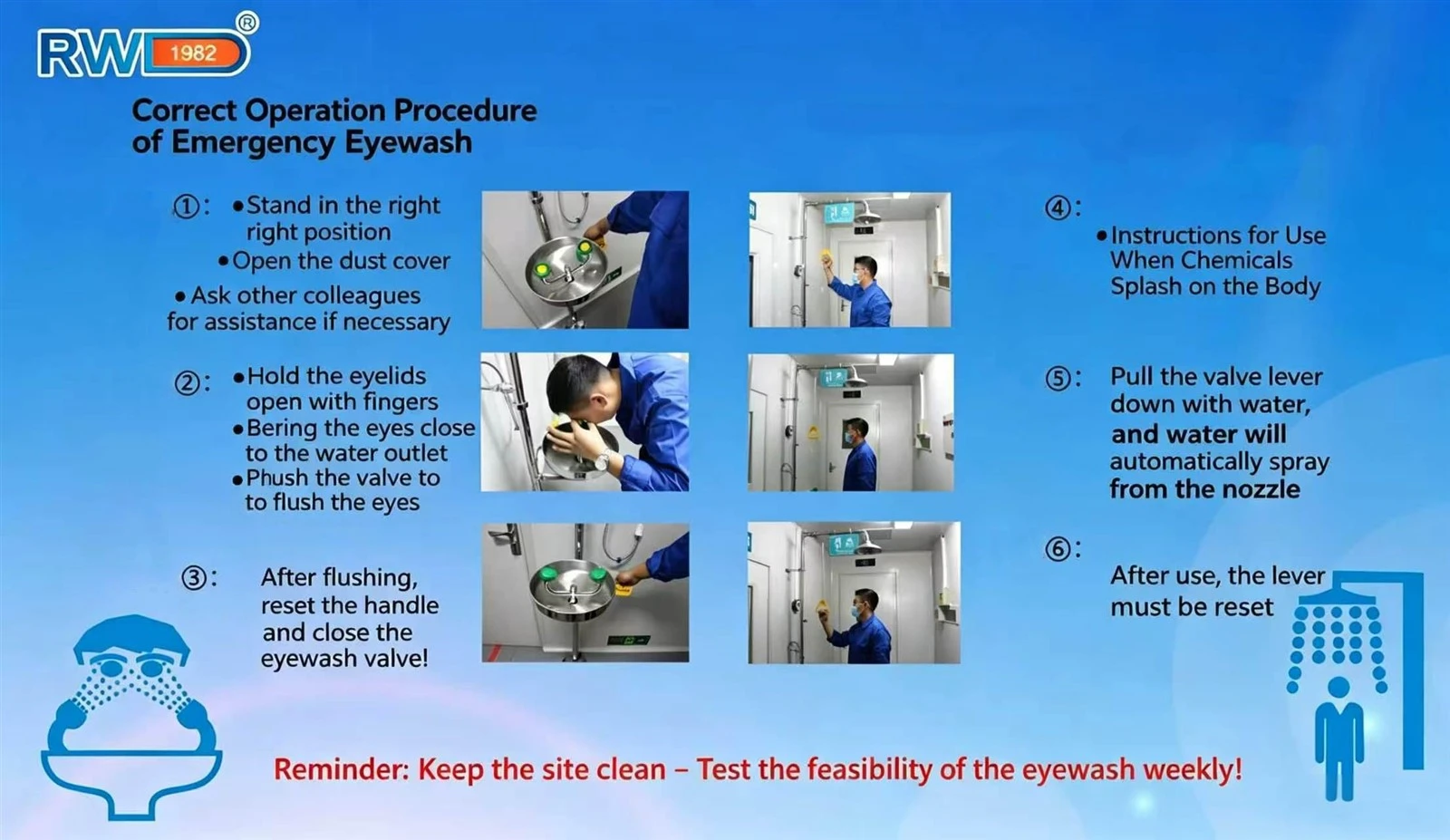
The core emergency handling principle stays consistent for all splash incidents: rinse contaminated skin or eyes on site first via qualified emergency equipment, and seek professional occupational medical care only after completing standard flushing. When chemicals, abrasive dust or high-temperature fluid splash onto eyes or facial skin, activate the eyewash device for steady water flow, hold upper and lower eyelids fully open, and rotate eyeballs gently to rinse every corner of eye tissue thoroughly. Do not stop flushing early, even if the stinging or pain fades, and keep rinsing continuously for 15 minutes; remove contact lenses if possible during rinsing. For full-body exposure to hazardous substances, pull the shower activation rod to turn on the water instantly, remove all contaminated clothing while running water, and rinse exposed skin thoroughly for 15 minutes, paying extra attention to hair, skin folds, and joint crevices where residue easily accumulates. For strong acid or alkali splash exposure, extend total flushing time to 30 minutes for enhanced protection before medical assessment.
Inspection & Routine Maintenance Tips
We simplify role-sorted inspection and maintenance routines to fit regular site management workflows, without complicated procedures. On-site frontline workers conduct basic weekly checks to clear blocked access paths, check intactness of emergency signs and nozzle dust guards, and inspect pipelines for visible damage. Facility EHS staff complete monthly functional tests by running each fixture for 3 to 5 minutes to drain stagnant pipeline water, meanwhile verifying stable water pressure and qualified water temperature. Our factory service technicians partnered with third-party safety auditors carry out annual compliance inspections, replace original OEM spare parts, and complete official site safety certification for installed Emergency Shower and Eye Wash units. Different fixture types require targeted upkeep. Outdoor plumbed fixtures need manufacturer-approved antifreeze kits for winter pipeline protection, and unauthorized pipeline cutting or modification is strictly prohibited. Portable self-contained eyewash requires full water replacement every six months, and only factory-formulated bacteriostatic rinsing fluid can be used for tank maintenance. Fixtures deployed in heavy-corrosion workshops adopt premium 316 stainless steel construction, with complimentary anti-corrosion coating repair covered under valid factory warranty.
Forbidden Behaviors & On-site Troubleshooting
Certain on-site behaviors are restricted to protect employee safety and preserve valid product warranty for onsite emergency safety systems. Site teams must never stack materials or block surrounding space around emergency stations, nor adjust main water valves without written approval from our after-sales team and on-site EHS department. Replacing standard onsite flushing water with saline or disinfectant solution is forbidden, as well as privately altering original nozzle internal structure. Additionally, dedicated emergency water is not allowed for daily workshop cleaning use. Most common onsite risks stem from neglected daily maintenance. Stagnant pipeline water breeds bacteria and leads to secondary eye infection, which can be avoided via monthly routine water flushing. Unregulated mixed hot and cold water causes cold shock or thermal scalds, so factory original thermostatic mixing valves are required for all fixed plumbing fixtures. Broken nozzle dust covers easily lead to outlet clogging, so damaged covers should be replaced timely during weekly site checks. For unexpected equipment malfunctions, follow simple onsite solutions: switch to certified backup portable eyewash once main water supply fails and contact our team for pipeline troubleshooting, clean clogged nozzles only with soft clean water without sharp piercing tools, and apply OEM nozzle replacement once parts get damaged. Cease fixture use immediately and transfer injured staff to nearby functional emergency stations if water temperature becomes abnormal.
Staff Training & Daily Quick Check Guidance
Basic emergency response training covering standard flushing operation is mandatory for all on-site staff to operate Emergency Shower and Eye Wash properly. New hires must master basic equipment activation and standard flushing protocols before starting official work, and site management should organize quarterly chemical splash emergency drills to improve overall team response efficiency. Daily pre-shift quick inspection takes little time, focusing on several core onsite items: clear unobstructed emergency access, intact emergency identification signage, locked-open main water valve, leak-free corrosion-free pipelines, undamaged eyewash dust covers, and responsive activation rods and foot pedals.


